
Cross-border and FX monitoring
Preserve original and settlement amounts, apply corridor and country context, and investigate risk across currencies, payment rails, fees, reversals, and refunds.
Read the guideWatchTower helps banks, fintechs, payment platforms, and digital asset businesses monitor transactions, screen counterparties, investigate alerts, and preserve the evidence behind every decision.
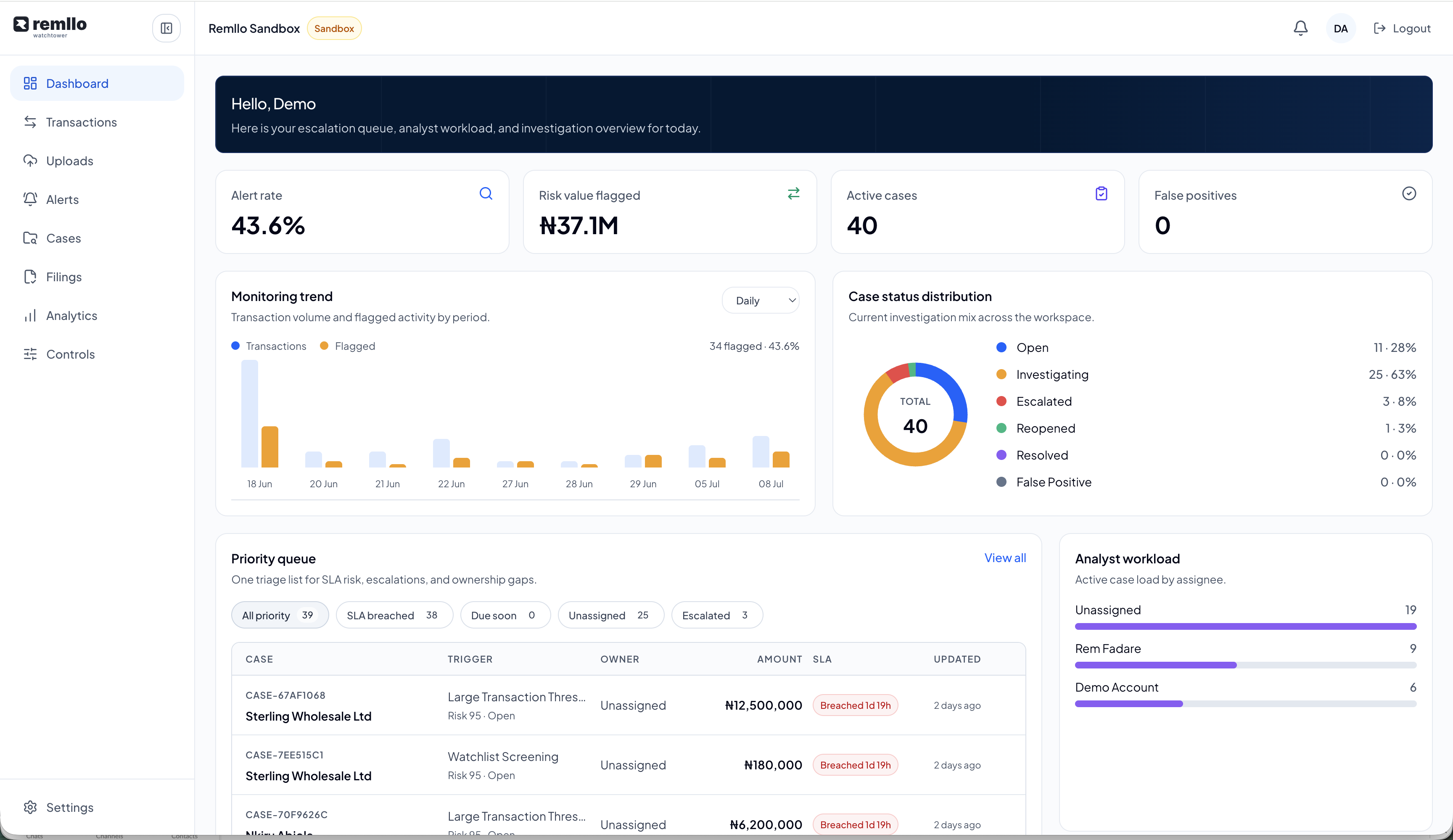
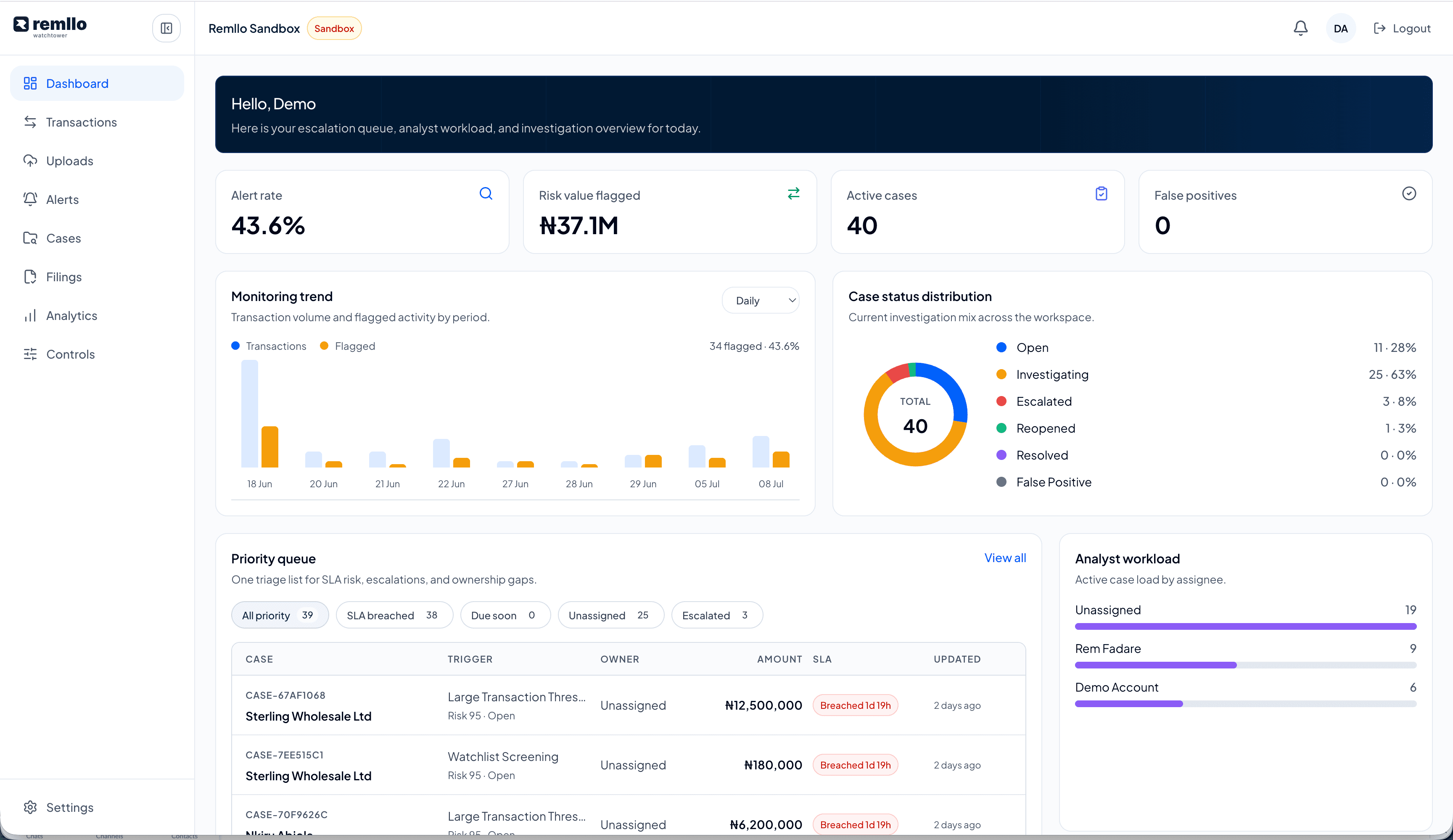
Product overview
Bring ingestion, monitoring controls, alert review, case evidence, and reporting preparation into one traceable workflow.
Apply rules, screening, behavioural signals, and cross-border context.
Allow, review, block, or request a step-up check where supported.
Investigations, decisions, and filing evidence stay connected.
Flexible deployment
Use live API ingestion for supported decisioning integrations, or monitor asynchronously through adapters and batch uploads.
WatchTower capabilities
Give risk teams the live activity, decision context, and case evidence they need without moving between disconnected tools.
Live monitoring
Stream events through the API, evaluate activity against rules and customer context, and return an allow, review, block, or challenge response where inline decisioning is supported.
Real-time decisions
Allow, review, block, or challenge
Customer context
Transactions and behaviour
Controls and decisions
Start with built-in AML and fraud typologies, add your own rules, and dry-run changes before production.
Rule preview
High value + new device
Investigations and reporting
Assign alerts, track SLAs, document the decision, and prepare reporting from the same case record.
Case CASE-2048
Unusual transfer sequence
Evidence
12 records
Filing readiness
Ready
Built for complex money movement
Apply the controls that fit your business, from local transfers to cross-border payments and digital asset activity.
Preserve original and settlement amounts, apply corridor and country context, and investigate risk across currencies, payment rails, fees, reversals, and refunds.
Read the guidePause suspicious but recoverable transactions for a step-up check, then continue automatically or route the result to an analyst based on your policy.
Read the guideScreen people, businesses, beneficiaries, and supported crypto wallet addresses against the official sources enabled for your organization.
Read the guideUse versioned official sources, tenant-specific lists, allowlists, and rescreening workflows while keeping source evidence connected to each match.
Read the guideApproved deployments can surface media findings from configured sources so analysts can verify the evidence and record a disposition.
Read the guideConnect velocity, device, beneficiary, location, and relationship signals as analyst evidence. Network signals remain advisory until validated for an organization policy.
Read the guideStart with built-in AML and fraud controls, add tenant-specific rules, and dry-run changes before activation.
Customer intelligence
Connect transactions and behavioural events to one customer profile, so activity such as a password reset followed by a large transfer reads as one risk story.
Use AI assistance where enabled while keeping controls, activation, and final investigation outcomes under team review.
01
Where enabled, describe the behaviour to monitor, review the drafted rule, and dry-run it before activation.
02
Use baseline and event signals to prioritize review. These signals support analysts and do not autonomously block activity.
03
Dry-run control changes and preserve who changed what before a rule reaches production monitoring.
Send eligible events through the API, an adapter, or a batch upload.
Apply active rules and screening controls to the available event context.
Create alerts with the transactions and signals that triggered review.
Assign cases, preserve evidence, and document the analyst decision.
Export case evidence or prepare goAML-ready XML when required.
Regulatory reporting
Run readiness checks, generate XML from captured case evidence, and preserve filing versions and status. Your team remains responsible for final review and submission.
Give analysts one place to review alerts, collaborate on cases, and preserve the final decision.
In compliance software, trust is specifics, not adjectives.
Selected sensitive customer fields use authenticated encryption at rest, with access restricted by service and operator permissions.
Rule changes, case actions, and decisions are preserved in the audit history.
Analysts, reviewers, and admins each see and do only what their role allows.
Machine-to-machine ingestion uses hashed API keys with optional IP allowlisting.
Customer fit
Built for financial businesses that need to understand money movement before and after a transaction is completed.
Monitor account and transfer activity while keeping AML investigations and reporting evidence connected.
Typical fit
Apply monitoring and fraud controls to high-volume payment activity, with inline responses where supported.
Typical fit
Monitor disbursements, repayments, and borrower activity for abuse and account takeover signals.
Typical fit
Monitor currencies, corridors, beneficiaries, payment purposes, sanctions exposure, reversals, and settlement activity.
Typical fit
Connect fiat and crypto activity while screening supported wallet addresses and investigating high-risk transfers.
Typical fit
Give the institutions on your platform isolated monitoring, decisioning, and investigation workflows through one integration model.
Typical fit
See how WatchTower can fit your ingestion model, monitoring controls, case operations, and reporting process.
WatchTower works alongside Remllo Compliance and Remllo Identity, connecting transaction monitoring, AML monitoring, regulatory compliance, and identity verification in one ecosystem.
Related solutions: Transaction Monitoring, AML Transaction Monitoring, Transaction Monitoring, Fraud Detection.
Product FAQ
Understand how WatchTower fits into transaction monitoring, AML investigations, fraud controls, and regulatory reporting workflows.
Remllo WatchTower gives banks, fintechs, lenders, payment companies, and other transaction-led financial institutions infrastructure for real-time transaction monitoring, AML review workflows, fraud detection, and alert investigation.
Yes. WatchTower is designed to handle anti-money laundering monitoring and fraud detection in the same risk operations environment so teams can investigate with shared context.
Yes. WatchTower supports real-time event ingestion and alerting. For supported inline integrations, a response can inform an allow, review, block, or challenge decision. Other deployments can monitor activity alongside the transaction flow.
It combines rules, behavioural context, and workflow automation, with AI-assisted rule drafting where enabled. Analysts remain responsible for reviewing controls and investigation outcomes.